 By Dr. Abner Mendoza
Published
Key takeaways
- A readiness estimate should identify work packages, assumptions and recurring ownership.
- Scope choices can shift costs into migration, integration and user workflows.
- Budget internal labor, evidence production and ongoing operation alongside subscriptions.
- Verify current assessment requirements before committing to a particular sequence or date.
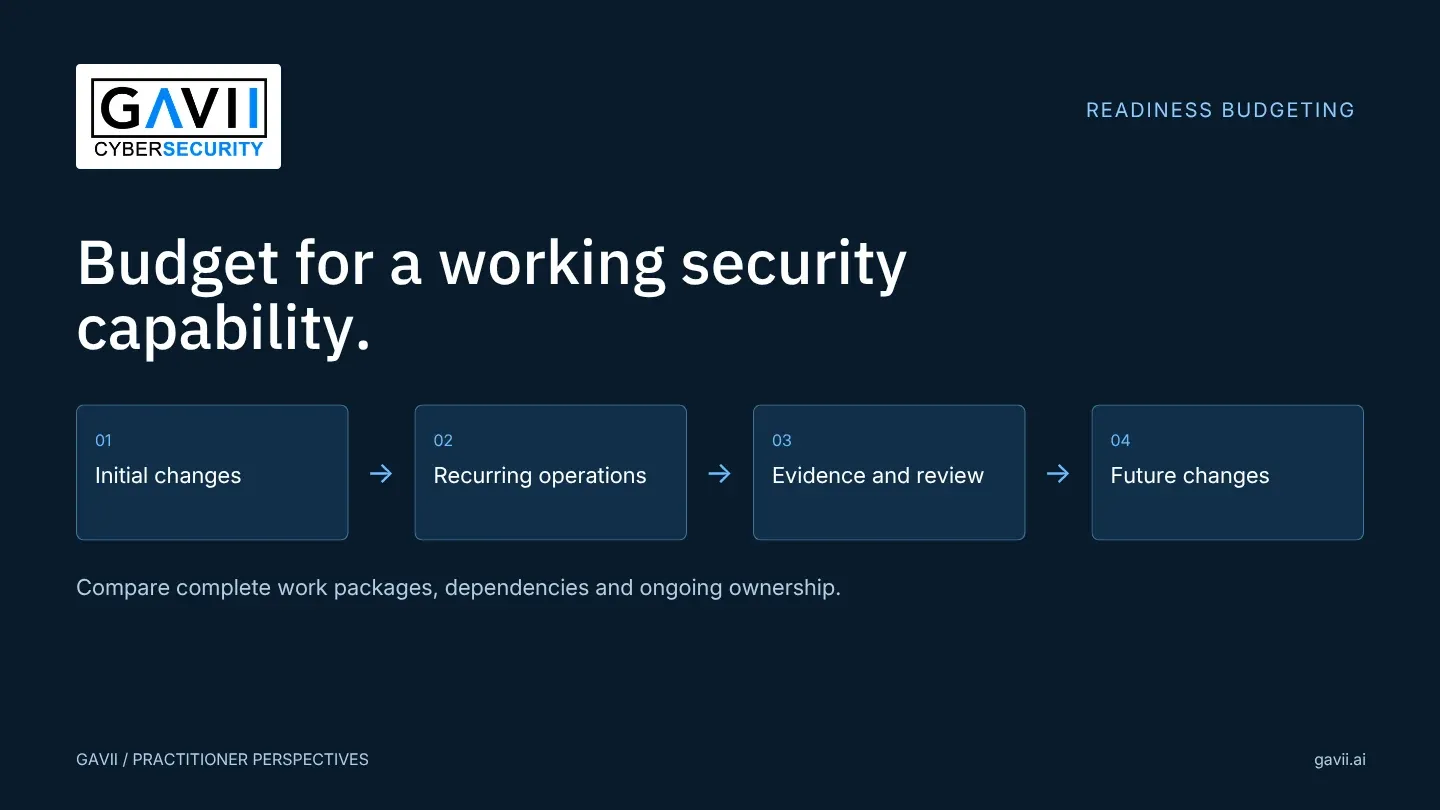
A CMMC readiness budget should consider and reflect how your organization will establish and sustain the required cybersecurity safeguards. A single consulting quote or software subscription cannot do that, because CMMC is an ongoing long term effort. The initial readiness work includes decisions about scope, implementation, staffing, evidence and ongoing operations, and those decisions influence one another.
As with most things, cheaper is rarely better. The most useful estimate is therefore a set of work packages with explicit assumptions. Leadership should be able to see what each package delivers, what must happen first, who will operate the result and which costs continue after the initial project. A low initial price can become expensive when those dependencies remain outside the proposal.
In this article, I present seven budgeting decisions. As much as I would like to, I cannot offer a universal price range because unfortunately there’s no one-size-fits-all approach here. Differences in information flows, existing implementation and contractual requirements make such figures unreliable without a defined environment. That said, we have done readiness work as low as $5,000 and as a high as $100,000+, and here is how we have seen clients work our their budgets…
1. Resolve the boundary before comparing solutions
Scoping is key! Identify where relevant information enters, is processed, is stored and is shared. Include administrative dependencies, backup destinations and external services. An estimate based only on employee count may miss the systems and providers that make the work possible.
Compare boundary options against actual business workflows. A smaller environment may reduce some implementation work while adding transfer procedures, separate identities or operational friction. Those costs need to appear in the comparison rather than being discovered after procurement.
The CMMC scoping rule provides the framework for identifying relevant assets and external service relationships. Use it to support a defensible boundary, not to manufacture the smallest possible diagram. 32 CFR 170.19
2. Separate existing capability from unfinished implementation
Mind the Gap! Inventory the controls you already have in operation and examine evidence that prove how they work across the relevant environment. A licensed feature is different from a configured feature, and a configured feature is different from one consistently operated and reviewed.
For each gap, identify the remaining work. It may involve configuration, a procedure, staff training, a provider change or several of these together. Avoid charging the same implementation work to multiple budget lines simply because it supports several requirements.
Record uncertainty explicitly. If the team cannot yet determine whether a provider supplies usable logs, budget a discovery task before assuming either a complete replacement or no additional work. A modest investigation can prevent a much larger incorrect purchase.
3. Include migration and integration work
Test it! Moving information into a different environment creates work beyond the destination license. Consider identity integration, account provisioning, endpoint configuration, data transfer, validation, user support and retirement of the former workflow. Define how business operations continue during the transition.
Test the proposed implementation. Can staff exchange required files with customers? Can administrators restore a needed record? Can authorized users perform the task without copying information into an uncontrolled workaround? These are design questions with budget consequences.
Include the effort to correct defects discovered during the pilot. A proposal that assumes every integration works immediately transfers that risk to the customer. The estimate should show which assumptions have been tested and which remain unresolved.
4. Price the operating responsibilities
Security controls need operators! Identify who processes access changes, reviews alerts, maintains configurations, updates documentation and responds to incidents. Decide whether existing staff have the time and competence for these duties or whether a provider must supply them.
Evaluate service descriptions at the activity level. “Managed security” may not include evidence exports, account reviews, incident coordination or assessment support. Ask what is delivered, how frequently, in which format and through which escalation process. Compliance management is much different than the work your MSP does.
An internal owner is still needed when work is outsourced. Budget time for reviewing provider performance, authorizing changes and resolving exceptions. A service contract does not remove the contractor’s responsibility to understand the environment and support its own representations.
5. Fund evidence production and maintenance
Where is the evidence? Evidence work is often underestimated because it is treated as a final documentation exercise. In practice, useful records arise from operating the actual security controls: approvals, review results, configuration history, training records and corrective actions.
Plan how those records will be collected, protected and retrieved. If the only person who knows how to obtain a report is unavailable, the organization has a dependency that should be addressed before an assessment or management review.
CMMC requires ongoing monitoring and system security plan requirements. The budget should cover maintaining the implementation and its description, not merely purchasing a template at the beginning.
6. Account for workforce time and operational disruption
Time is money! Employees need to learn new handling procedures and perform security duties within their actual roles. Include training, practice, support and management participation. These activities consume time even when no external invoice is generated.
Schedule changes around operational constraints. A manufacturer may need a maintenance window and equipment-vendor participation. A small professional-services company may need coverage while its administrator completes implementation work. Treating these constraints as free availability produces an unrealistic plan.
Distinguish required operating effort from temporary project effort. A short implementation surge may be manageable, while an ongoing process that depends on the same overextended employee may fail. Leadership needs to see that difference before approving the budget.
7. Reserve capacity for assessment and change
Determine which assessment activities apply to the organization’s current procurement requirements. Separate readiness work from internal review, any applicable external assessment, and subsequent corrective work. Do not combine them under a vague promise of “CMMC certification.”
Yes, CMMC third party assessments are currently on pause, but CMMC compliance was never paused. The Phase 1 self-assessment requirement remains in full effect. Verify your current contract instructions before committing funds to a particular assessment sequence or date, and plan for those additional resources required for a resumption of third party audits in some for or the other. Class Deviation 2026-O0025, Revision 3
Plan for where you want to be, and budget accordingly. Include a mechanism for revising the estimated budget when assumptions change. A new customer requirement, service boundary or business location may alter the work. Contingency should address identified uncertainty, with an owner and a decision trigger, rather than conceal an unexplained percentage.
| Work package | One-time effort | Continuing obligation | Assumption to verify |
|---|---|---|---|
| Identity and access | Configure roles and migrate accounts | Approvals, reviews and departures | Provider responsibilities and licensing |
| Information handling | Establish approved workflows | Monitor changes and exceptions | Customer exchange requirements |
| Recovery | Configure and test restoration | Maintain backups and exercise recovery | Dependencies and available operators |
| Evidence | Establish record locations and ownership | Produce, review and retain records | Export access and usable formats |
| Workforce | Prepare role-specific instruction | Train new staff and changed roles | Staff availability and learning needs |
| Assessment | Evaluate applicable scope and objectives | Affirmations and reassessment as applicable | Current contract and program requirements |
Compare proposals using the same assumptions
Consider a contractor comparing a bundled environment with improvements to its existing systems. The bundled option includes licensing and deployment but excludes migration of historical project records. The existing-system option includes migration work but assumes the customer will operate several controls internally. Comparing their headline prices would conceal the real difference.
Ask both providers to respond to the same workflow, boundary and responsibility requirements. Identify exclusions and recurring charges, then add the customer’s own labor and dependencies. Require a description of the deliverable for each major work package so that acceptance can be checked.
The resulting budget becomes a management instrument. Leadership can fund the next dependency, evaluate progress and challenge unsupported assumptions without pretending that a purchase alone establishes readiness. GAVII’s compliance planning services can support that connection between scope, implementation priorities and the evidence needed to evaluate the result.
Back to articles